VedicSync › Guides › Doshas › Kaal Sarpa Dosha
Dosha
Kaal Sarpa Dosha
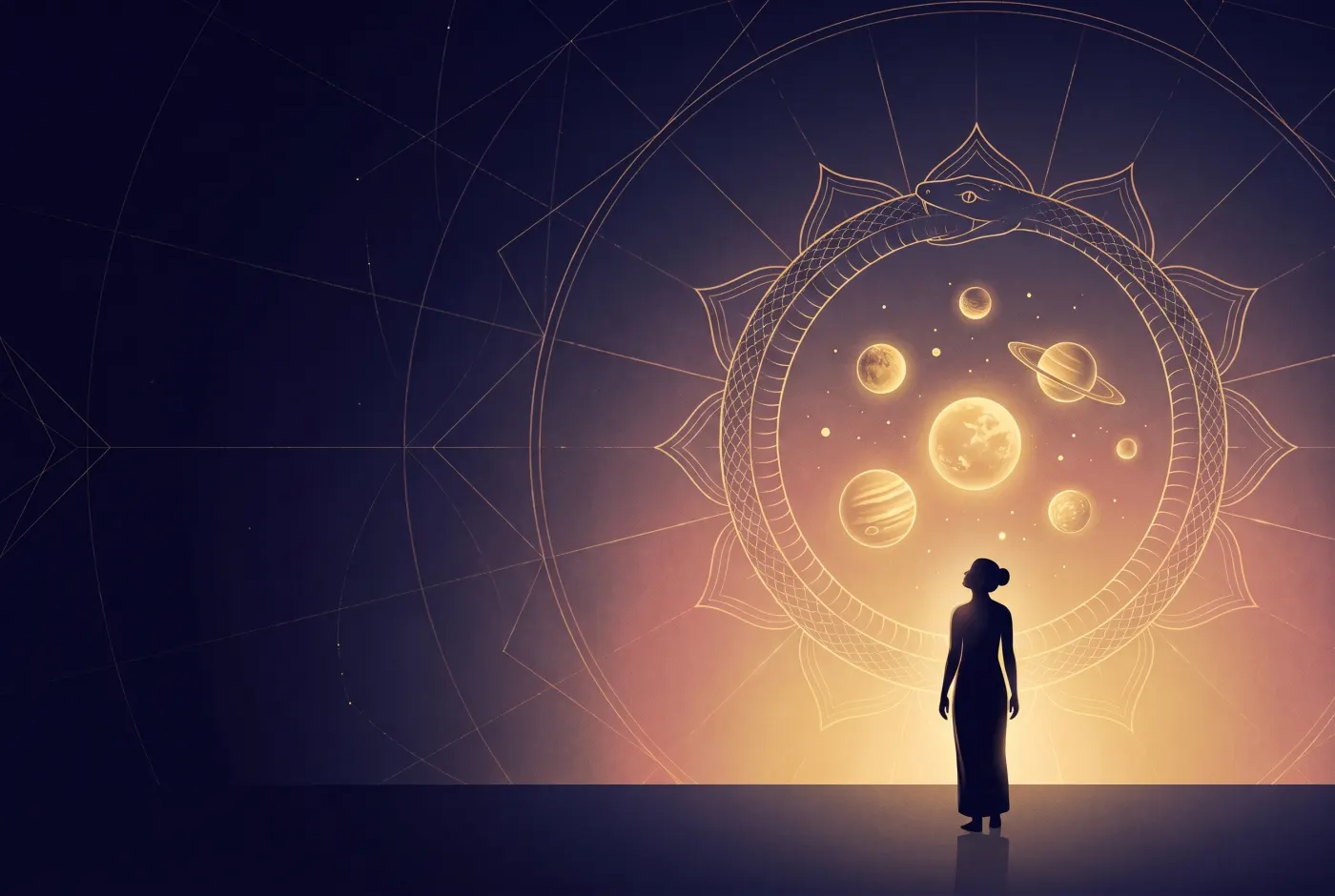
Formed when every one of the seven visible planets is caught on one side of the Rahu–Ketu axis — the whole chart 'swallowed' between the lunar nodes, like a snake with its head and tail closing the circle.
| Also known as | Kala Sarpa Yoga · the serpent of time |
|---|---|
| Formed by | All seven planets (Sun through Saturn) hemmed between Rahu and Ketu, with none escaping the nodal axis. |
| Chiefly affects | The overall rhythm of a life: early struggle, delayed results, sudden turns. |
| Classical remedy | Rahu–Ketu propitiation, Nag Panchami, and the Trimbakeshwar puja. |
What Kaal Sarpa Dosha is
Rahu and Ketu are the two points where the Moon's path crosses the Sun's — the shadow 'planets' that in myth are the severed head and tail of a serpent. When all seven physical planets fall between them, on one arc of the zodiac, the chart is said to be held inside the serpent's coils. The result is read as a life of concentrated karma: obstacles early, and — this is the part the scary write-ups omit — often marked success once the pattern is worked through.
The twelve forms
The dosha is not one thing. Depending on which house Rahu occupies, it takes one of twelve named forms — Anant, Kulik, Vasuki, Shankhpal, Padma, Mahapadma, Takshak, Karkotak, Shankhachud, Ghatak, Vishdhar and Sheshnag — each colouring a different area of life. There is also a distinction between a full Kaal Sarpa (every planet strictly enclosed) and a partial one, which is far milder.
What tradition says it affects
The classic signature is effort that meets resistance: things arrive late and the hard way, ambitions stall before they surge, and life turns on sudden, fated events. But Rahu is also the planet of unconventional heights, and many high achievers carry this yoga. Read well, it describes intensity and a late, hard-won peak rather than simple misfortune.
Traditional remedies
Remedies centre on honouring the serpent energy rather than fighting it: worship on Nag Panchami, chanting of the Rahu and Ketu beeja mantras, Maha Mrityunjaya recitation, and the well-known Kaal Sarpa Shanti puja performed at Trimbakeshwar near Nashik. The steady counsel is that the pattern rewards persistence — its results tend to come in the second half of life.
Common questions
How do I know if I have Kaal Sarpa Dosha?
Cast your chart and look at Rahu and Ketu: if every other planet sits on one side of the line joining them, with none on the other, the dosha is present. Your free VedicSync chart plots all nine, so the pattern is visible at a glance.
Is Kaal Sarpa Dosha always bad?
No. It concentrates a life's karma into sharper highs and lows, and it is commonly found in the charts of very successful people. It describes intensity and delayed reward, not guaranteed hardship.
What is the most common remedy?
The Kaal Sarpa Shanti puja at Trimbakeshwar is the best-known, alongside Nag Panchami observance and Rahu–Ketu mantra practice.
See this for your own chart
Everything above is computed from the live sky. Enter your birth details to get your personal chart, dasha timeline, and today’s transits — free, no signup needed.
Cast my free birth chart →